
tinyzombies
Registered User
ERAS starts with the evidence that survives. For modern players, that includes tracking and advanced statistics. For historical players, it includes biographies, newspaper accounts, voting, awards, team roles, and contemporaneous descriptions of abilities. If Harry Cameron is repeatedly described as one of the fastest players in hockey, a major puck carrier, and a central figure in attack creation, that is treated as evidence. The first task is to determine what abilities the player possessed and what role he was actually performing.
Once the role is established, the next step is to reconstruct the environment surrounding that role. A shutdown defenseman, an offensive defenseman, a transition driver, and a scoring winger operate under different burdens and constraints. Team structure, roster composition, deployment, competition, and responsibility all contribute to the environment. The player is then evaluated relative to the other players performing similar roles within his own era. Some traits are expressed through role ratings, while others use broader bands such as L/M/H (Low, Medium, High) for concepts like Control of Play, Connector, and Partner Elasticity, where evidence supports classification but not false precision.
Only after role and environment are established do we attempt to estimate the environment numerically. Team results, player results, scoring environments, usage patterns, and relative dominance are used to infer an xGF and xGA environment. For modern players these values may closely resemble directly measured data. For historical players they are reconstructions. The process therefore moves from evidence → role → environment → inferred xG environment → results. In that sense, ERAS is not trying to estimate talent directly. It is trying to reconstruct the difficulty of the environment in which a player's achievements occurred.
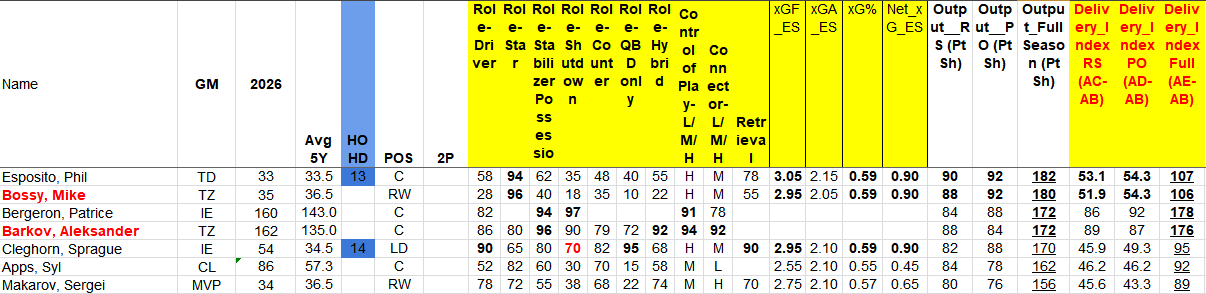
Once the role is established, the next step is to reconstruct the environment surrounding that role. A shutdown defenseman, an offensive defenseman, a transition driver, and a scoring winger operate under different burdens and constraints. Team structure, roster composition, deployment, competition, and responsibility all contribute to the environment. The player is then evaluated relative to the other players performing similar roles within his own era. Some traits are expressed through role ratings, while others use broader bands such as L/M/H (Low, Medium, High) for concepts like Control of Play, Connector, and Partner Elasticity, where evidence supports classification but not false precision.
Only after role and environment are established do we attempt to estimate the environment numerically. Team results, player results, scoring environments, usage patterns, and relative dominance are used to infer an xGF and xGA environment. For modern players these values may closely resemble directly measured data. For historical players they are reconstructions. The process therefore moves from evidence → role → environment → inferred xG environment → results. In that sense, ERAS is not trying to estimate talent directly. It is trying to reconstruct the difficulty of the environment in which a player's achievements occurred.