Analytics: Interpretation and true value | HFBoards - NHL Message Board and Forum for National Hockey League

Analytics: Interpretation and true value

  • If you are having issues logging in, we have found opening the log in page in a new tab/window rather than using the pop out should resolve these issues. We are working to get this resolved and thank you for patience.

Peabody

Registered User
Apr 30, 2026
36
26
I'm very interested in how analytics may be useful in both interpreting performance or "predicting" possible performance moving forward. I see issues and consistency problems when interpreting stats related to both proxies for possession or shot quality.

Possession proxies seem less interesting to me at the moment, so starting with xGF. When looking at a seasons worth of data. And evaluating xGF for the top and bottom teams (as measured by wins, losses, points or goals). I'm not seeing consistent patterns or consistent explanations for variance, (beyond goals or W/L). I realize a single number can't tell the entire story, just interested in how others are using this information.

If anyone has had a different experience, Could you post some solid statistical usage that you have found reliable using xGF or other "analytics".
 
Last edited:
I'm very interested in how analytics may be useful in both interpreting performance or "predicting" possible performance moving forward. I see issues and consistency problems when interpreting stats related to both proxies for possession or shot quality.

Possession proxies seem less interesting to me at the moment, so starting with xGF. When looking at a seasons worth of data. And evaluating xGF for the top and bottom teams (as measured by wins, losses, points or goals). I'm not seeing consistent patterns or consistent explanations for variance, (beyond goals or W/L). I realize a single number can't tell the entire story, just interested in how others are using this information.

If anyone has had a different experience, Could you post some solid statistical usage that you have found reliable using xGF or other "analytics".

Would be curious seeing very basis regression numbers between GF% and goals differential or team point totals.
 
xGF% was never intended to be a 'one number that rules them all and binds them' type stat. It was developed to improve upon Corsi's predictive capability for future goal differential (and, by extension, wins), since Corsi was far and away the best predictor of future goal differential and future wins, well ahead of traditional numbers like current/past goal differential or current/past win%.

If you're looking for that kind of number, I'd look into the work being done on GAR, xGAR, and WAR models.

As far as use cases and best practices for xGF%, it depends on how far ahead you’re trying to predict and how much past data you’re using to make the prediction, and understand why.

Would be curious seeing very basis regression numbers between GF% and goals differential or team point totals.

There's plenty of data out there about this now; we know that 5v5 xGF% and 5v5 CF% are both better predictors of future GF% (goal differential) than current GF% and standings points.

Hell we've known this since the first publicly available xGF model was published by DTMAboutHeart, who has since been hired by the Colorado Avalanche (awhile ago now, well before their cup win).


That was a decade ago. xGF models have become more accurate as various modelers have tweaked the inputs and the weighting.

Corsi remains the largest input into any xGF model, obviously.
 
Last edited:
  • Like
Reactions: MiscBrah
I don't think hockey can predict that, it is too random. So many hattricks in history are 3 weird goals and also look at Marner he gets a finals hattrick in game 3 after not scoring a playoff goal since the 2nd round.
 
xGF% was never intended to be a 'one number that rules them all and binds them' type stat. It was developed to improve upon Corsi's predictive capability for future goal differential (and, by extension, wins), since Corsi was far and away the best predictor of future goal differential and future wins, well ahead of traditional numbers like current/past goal differential or current/past win%.

If you're looking for that kind of number, I'd look into the work being done on GAR, xGAR, and WAR models.

As far as use cases and best practices for xGF%, it depends on how far ahead you’re trying to predict and how much past data you’re using to make the prediction, and understand why.


There's plenty of data out there about this now; we know that 5v5 xGF% and 5v5 CF% are both better predictors of future GF% (goal differential) than current GF% and standings points.

Hell we've known this since the first publicly available xGF model was published by DTMAboutHeart, who has since been hired by the Colorado Avalanche (awhile ago now, well before their cup win).


That was a decade ago. xGF models have become more accurate as various modelers have tweaked the inputs and the weighting.

Corsi remains the largest input into any xGF model, obviously.
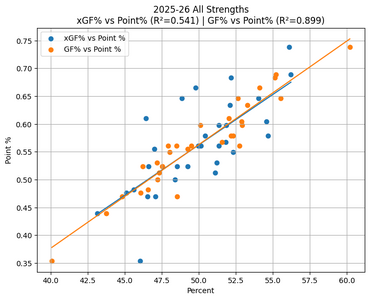
Here is plotted Relationship between team Point % and both GF% and xGF% for all NHL teams (2025-26, all strengths)(data from NST).

Could you attach a link to any one of those sources of data that shows a correlation between results and xGF that is more significant than the correlation between those same results and actual Goals. Would be very helpful. Any season is helpful. Much appreciated.
 

Attachments

  • GFpct_xGFpct_vs_Pointpct.png
    GFpct_xGFpct_vs_Pointpct.png
    50.4 KB · Views: 2
Here is plotted Relationship between team Point % and both GF% and xGF% for all NHL teams (2025-26, all strengths)(data from NST).

Could you attach a link to any one of those sources of data that shows a correlation between results and xGF that is more significant than the correlation between those same results and actual Goals. Would be very helpful. Any season is helpful. Much appreciated.

What are you trying to predict here?

This seems like you just did a basic correlation of stats at the end of a season?

I don't think anybody would argue that after 82 games, the team with the best goal differential would have a high probability of having the most wins that season.

What people would argue is whether the team with the best goal differential and/or most wins was actually winning based on controllable, sustainable factors, or whether they should be worried about their success in the playoffs or the next season.

Looking back at 82 games after the fact, Corsi and xGF are limited to descriptive value (what happened) vs predictive value (what is likely to happen next).

Corsi and xGF aren't without value in a descriptive regard; they can tell you who had the puck more, who had more chances, and what kind of chances and from where, who was overrelying on unsustainable PDO, etc.

There's a whole forum for discussing this kinda stuff.
 
What are you trying to predict here?

This seems like you just did a basic correlation of stats at the end of a season?

I don't think anybody would argue that after 82 games, the team with the best goal differential would have a high probability of having the most wins that season.

What people would argue is whether the team with the best goal differential and/or most wins was actually winning based on controllable, sustainable factors, or whether they should be worried about their success in the playoffs or the next season.

Looking back at 82 games after the fact, Corsi and xGF are limited to descriptive value (what happened) vs predictive value (what is likely to happen next). It's not without value, but that's not really what they're for.
I'm not arguing any postion. And that is what that plot is. I've been tryng to convince myself that xGF was useful for something. Somehow measuring past performance, exposing variance that can be somewhat understood, or predict future performance. I couldn't do it.

So no argument. I'm asking for input, from people like you that have been able to convince yourself of value. I'm truly just asking, how did you that.
I ran test on a year of regular season data, trying to find usability in the prediction of any actual results of the next season. Of course nothing, too many other variables. So I looked at xGF over shorter term than a season, I couldn't find any value.

What have you found to be the best example of one or two usages of xGF, that is not better understood from using goals over that same period. (I get the noise issue, but I can't prove xGF is more useful)
 
I guess Moneyball was a good movie but A's still lost in the end...

Like AI, it can probably give you some quick insight but doesn't replace the eye-test

If I recall correctly Habs were severley bashed trading for Weber based on his advanced stats and yet when healthy he was one of our best overall defencemen since Larry Robinson
 
  • Like
Reactions: Summer Rose
xGF% was never intended to be a 'one number that rules them all and binds them' type stat. It was developed to improve upon Corsi's predictive capability for future goal differential (and, by extension, wins), since Corsi was far and away the best predictor of future goal differential and future wins, well ahead of traditional numbers like current/past goal differential or current/past win%.

If you're looking for that kind of number, I'd look into the work being done on GAR, xGAR, and WAR models.

As far as use cases and best practices for xGF%, it depends on how far ahead you’re trying to predict and how much past data you’re using to make the prediction, and understand why.


There's plenty of data out there about this now; we know that 5v5 xGF% and 5v5 CF% are both better predictors of future GF% (goal differential) than current GF% and standings points.

Hell we've known this since the first publicly available xGF model was published by DTMAboutHeart, who has since been hired by the Colorado Avalanche (awhile ago now, well before their cup win).


That was a decade ago. xGF models have become more accurate as various modelers have tweaked the inputs and the weighting.

Corsi remains the largest input into any xGF model, obviously.

I actually meant xGF% not GF% and yes specifically 5 on 5. I always forget that caveat.
 
With hockey, you have to look at quite a few different stats to get the full picture. The data works the best when you see some outlier scenarios.

e.g. Ottawa last season dominated xGF% for most of the season (top-5 team) but was at the bottom of the East for a good chunk of the year. It showed you they were good candidate to have a strong finish if they got their goaltending figured out. But you had to look at the goaltending metrics to ensure that was the reason they weren't winning more games (and not, for example, controlling play for large portions and then giving up high-danger chances at a higher rate than other teams).

Another example is Montreal, which is very high in the standings, but the underlying numbers were troubling. Good candidate to regress next year unless they can improve their 5v5 play. Saw them get exposed against Carolina because of that issue, exactly.

I would say, if you want to get a sense of who is playing well in the NHL at any given time, it is better to go look at the MoneyPuck power rankings than it is to go and look at the standings.
 
  • Like
Reactions: Relapsing
With hockey, you have to look at quite a few different stats to get the full picture. The data works the best when you see some outlier scenarios.

e.g. Ottawa last season dominated xGF% for most of the season (top-5 team) but was at the bottom of the East for a good chunk of the year. It showed you they were good candidate to have a strong finish if they got their goaltending figured out. But you had to look at the goaltending metrics to ensure that was the reason they weren't winning more games (and not, for example, controlling play for large portions and then giving up high-danger chances at a higher rate than other teams).

Another example is Montreal, which is very high in the standings, but the underlying numbers were troubling. Good candidate to regress next year unless they can improve their 5v5 play. Saw them get exposed against Carolina because of that issue, exactly.

I would say, if you want to get a sense of who is playing well in the NHL at any given time, it is better to go look at the MoneyPuck power rankings than it is to go and look at the standings.
Ya, What your are describing is a combination of eye test in conjunction with some key numbers. Try to connect the dots and see if your instincts can be proven out, as the future unfolds. I think Montreal is a great example.

I was hoping to hear how fans and hobby hockey analysts actually use and learn from analytics. What they look at, what it tells them, how it informs their take on games they may or may not have seen.

This article from Hockey Graphs is an interesting read, on how some of the early analytics pioneers tried to make sense of the numbers. I admit that I may have missed the section discussing any extensive forward testing. But much of the article focused on analysis of completed games and seasons. If there are long term out-of-sample or forward testing results, I would be interested in seeing them. It would help explain why some of the adjustments and inputs add predictive value beyond fitting a model to historical data.

Expected Goals are a better predictor of future scoring than Corsi, Goals


Users who are viewing this thread

Ad

Ad